No matter your AI model’s framework, cloud platform or GenAI model provider, Deeploy makes the deployment and onboarding process simple. Whether it’s a new model or not, get it integrated into your governance workflow, without the usual integration headaches.
Deploying AI models into production is often a slow, resource-heavy process involving multiple tools, platforms, and complex pipelines. Integrating with existing infrastructure and ensuring models run efficiently across different environments can lead to delays, errors, and scalability issues.
Deeploy streamlines the deployment process, making it faster and easier to deploy and integrate AI models into your tech stack.
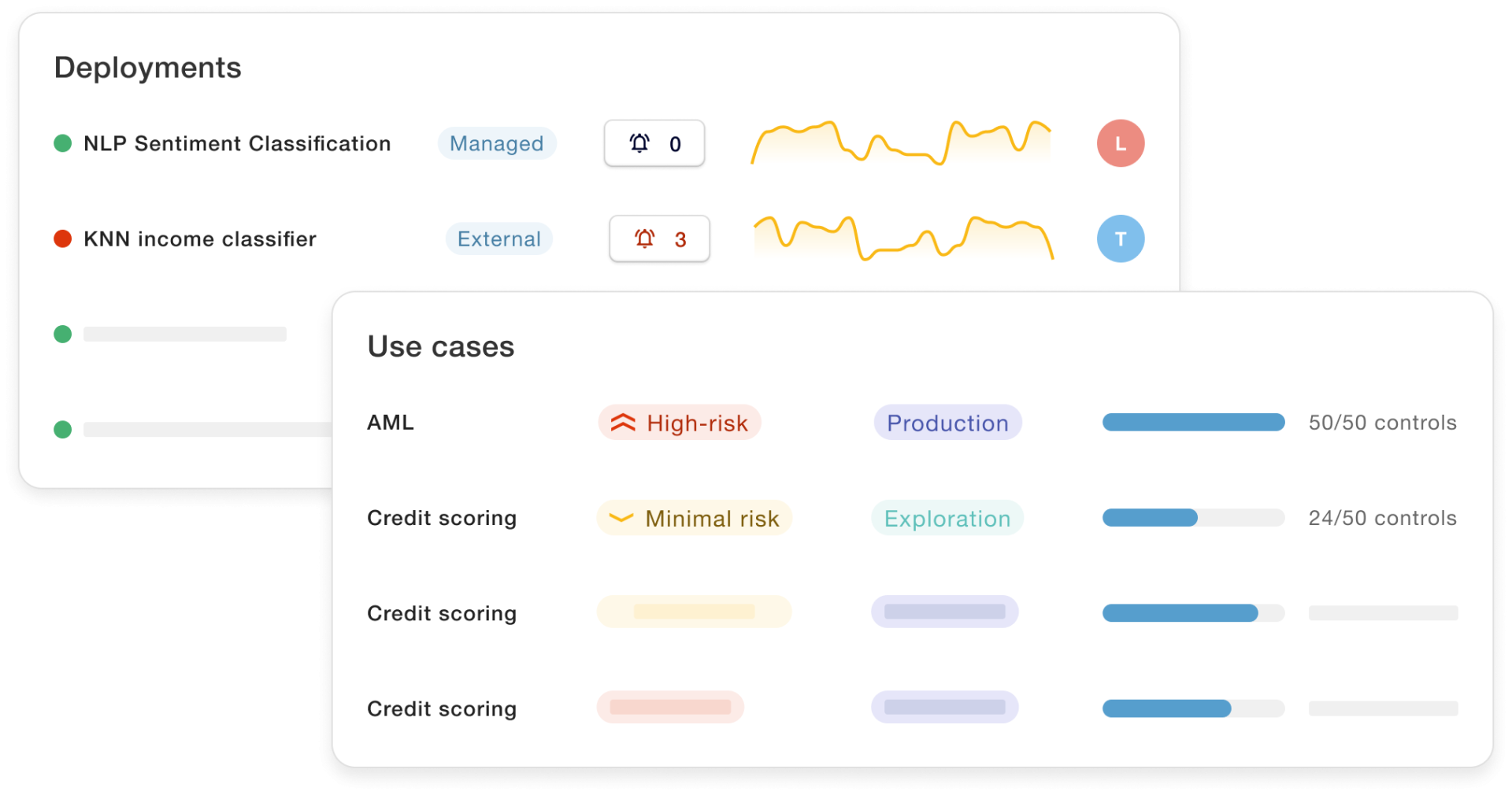
Centralise and govern all AI activity with a unified registry that captures every model and use case across your organisation, from in-house developments to vendor solutions, ensuring nothing goes into production without proper oversight.
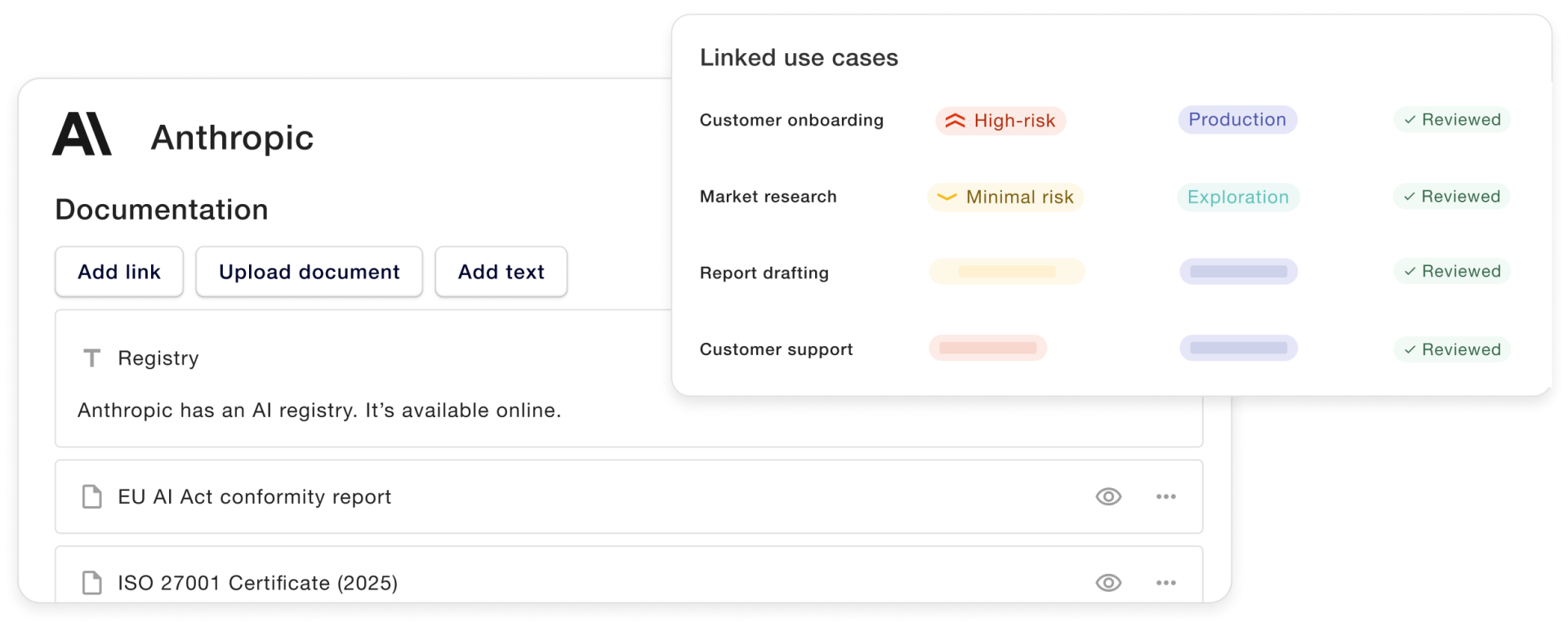
Manage third-party AI risk with a centralised vendor registry that tracks documentation, verification status, and use case dependencies across your entire AI supply chain.
Eliminate blind spots by discovering all AI systems in your organisation and bringing them into your registry, ensuring every system is tracked and governed.
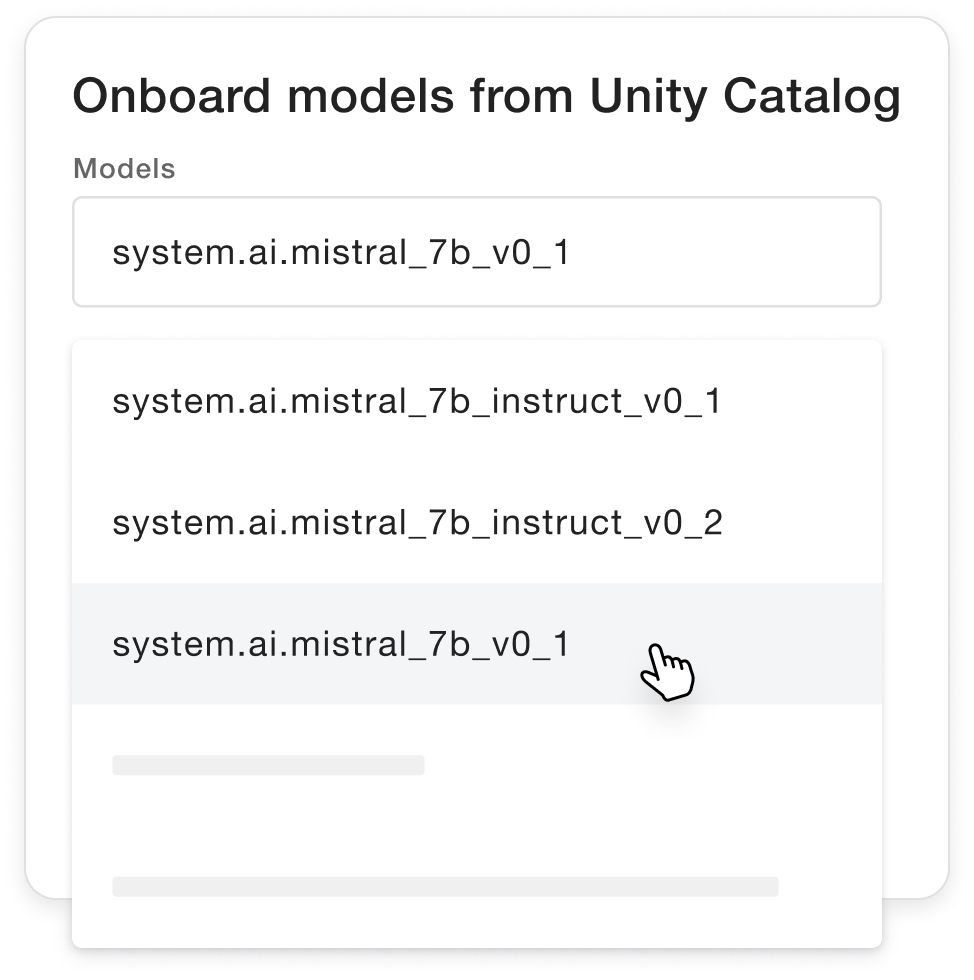
Turn model deployment into a simple, standardised workflow that takes minutes instead of days.
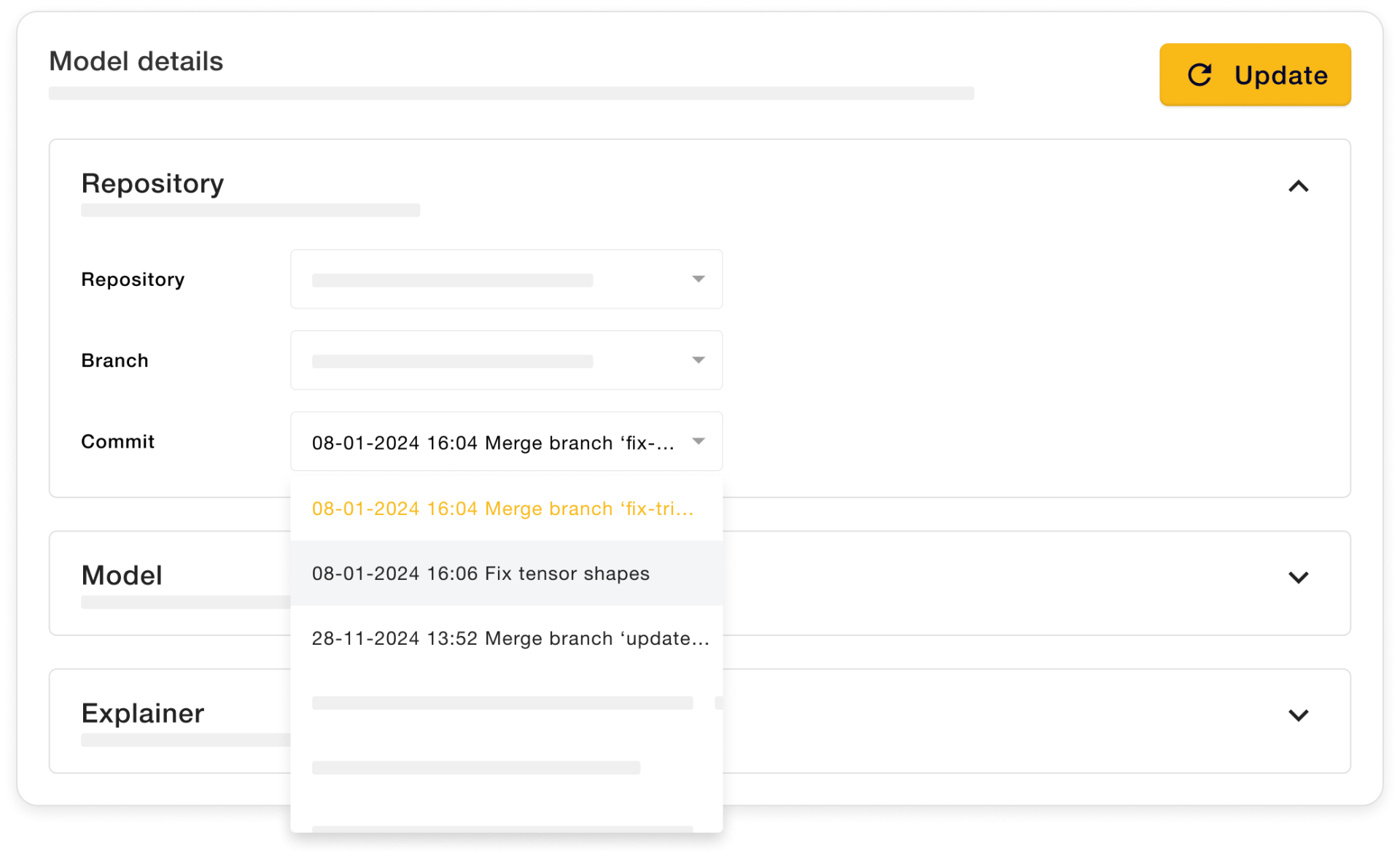
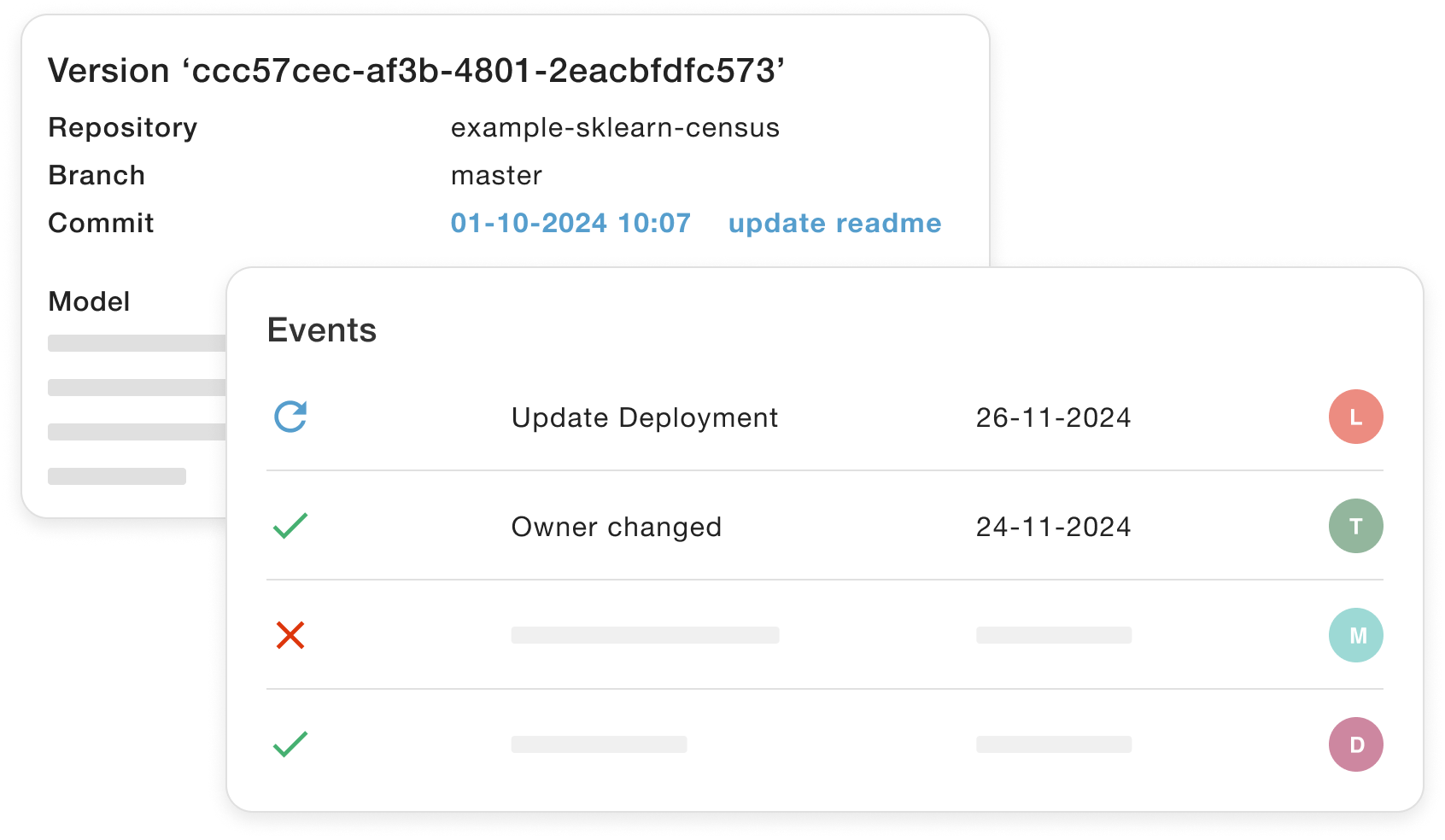
Track every change with automatic versioning and comprehensive audit logs that capture all updates, approvals, and configuration changes, enabling instant rollbacks and complete traceability.
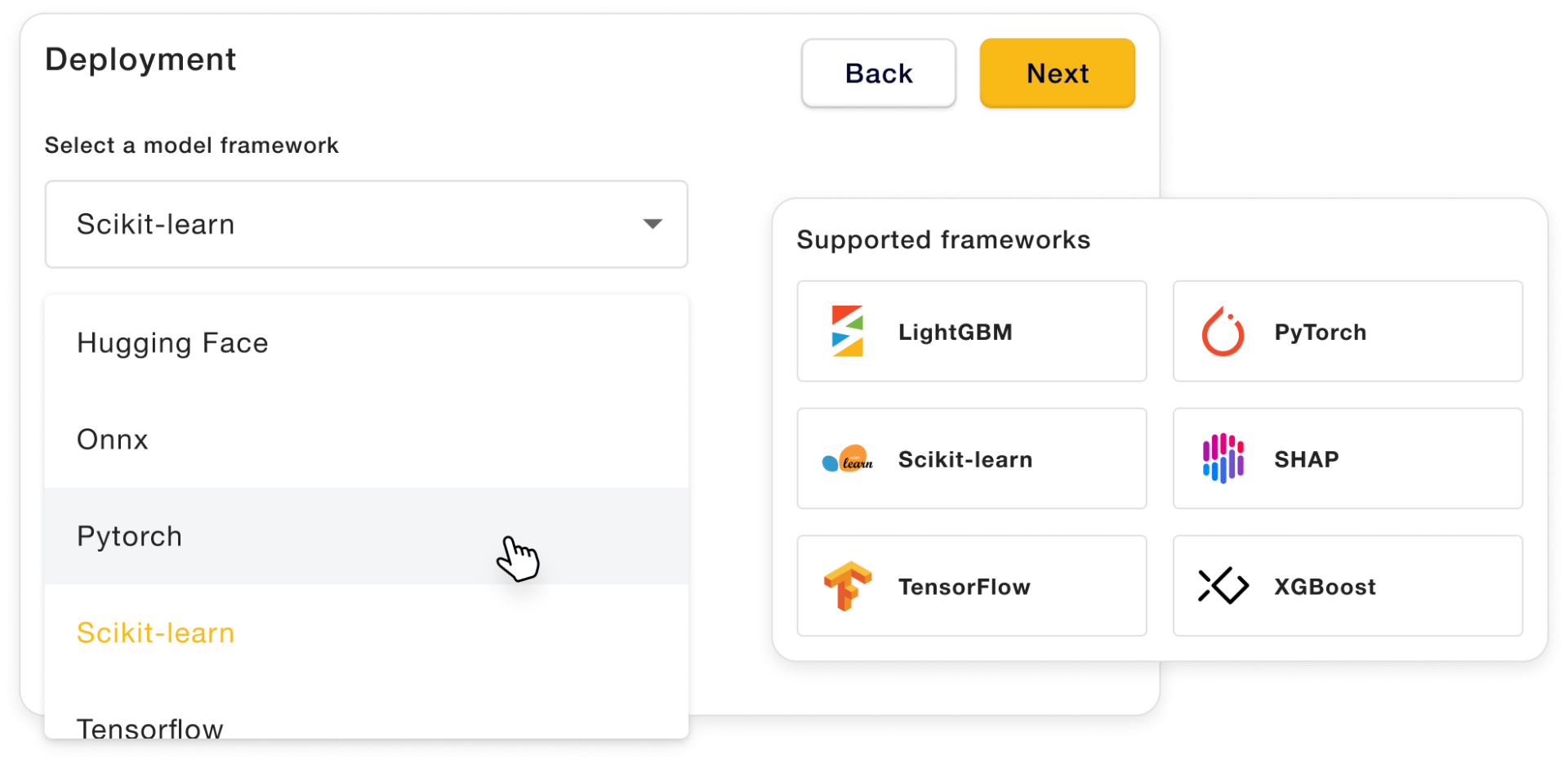
Onboard any AI system with native support for leading platforms like OpenAI, Mistral, and Databricks, plus open-source frameworks including Triton, PyTorch, Hugging Face, and XGBoost.
Deeploy integrates effortlessly with your existing infrastructure and MLOps integrations like MLflow, KServe, and others. Manage and automate your end-to-end AI lifecycle with ease.

Start organising your AI today
Discover how Deeploy can be applied in various industries
The AI registry is a unified, organisation-wide overview of every AI system you operate, regardless of where or how it’s deployed. It covers models managed directly within Deeploy, models running on external infrastructure that are connected to Deeploy via an API, and registration deployments used to bring existing systems under governance without migrating them.
Alongside the AI registry sits the use case registry, which gives the same organisation-wide visibility at the use case level, showing risk classification, control framework compliance progress, review status, and ownership for every AI application across all teams and workspaces.
The distinction between the two is worth noting: a use case represents a specific application of an AI model and spans its entire lifecycle, from exploration through to production. A deployment is the actual model implementation associated with that use case. One use case can have multiple deployments, and each deployment can be independently monitored and governed.
Together, the registries ensure that nothing goes into production without proper oversight, and that compliance teams always have a complete, current picture of your organisation’s AI footprint.
The vendor registry gives you a centralised place to document and track every external AI vendor your organisation depends on. For each vendor, you can store links, upload documents such as conformity reports or security certificates, and add free-text notes, building a complete evidence file for that vendor in one place.
You can also complete our vendor assessment template and upload it to the vendor page to formally evaluate how the vendor meets your organisation’s requirements.
Once a vendor is documented, you link them to the relevant use cases in your registry, making the dependency explicit and traceable. The vendor page then surfaces all linked use cases alongside their risk classification, governance completion percentage, review status, and owner. Compliance and procurement teams can see at a glance which internal AI systems depend on a given third-party model or platform, and whether those use cases are in good standing.
Deeploy supports three deployment types to accommodate different situations.
A managed deployment is where Deeploy hosts and serves the model directly using KServe, SageMaker, or Azure Machine Learning, giving you the full feature set including explainability, monitoring, alerts, and prediction logs.
An external deployment connects to a model already running on external infrastructure via an endpoint, useful for models hosted on platforms like Azure OpenAI or IBM watsonx.
A registration deployment is used to register any AI system, including third-party vendor models or even ideas pre-development, without deploying it, primarily for governance tracking and documentation purposes. All three types can be linked to a use case and governed through Deeploy’s control framework.
Every change to a deployment, whether a model update, configuration change, or approval decision, is automatically versioned and logged.
Each deployment version is linked to a specific Git commit, making it possible to trace exactly what code and model artefact was running at any point in time.
The organisation-level audit log captures all successful resource changes with timestamps and actor details, viewable as a summary, formatted breakdown, or raw data.
For deployment-specific events, a separate deployment events log tracks the full lifecycle of each version. Combined, these give teams a complete, auditor-ready change history.
For managed deployments, Deeploy natively supports PyTorch, TensorFlow, Scikit-learn, XGBoost, LightGBM, CatBoost, Hugging Face, and NVIDIA Triton.
GPU support is available for PyTorch (CUDA ≥12.1), TensorFlow (CUDA ≥11.2), Hugging Face, and Triton.
If your model uses a framework outside this list, you can deploy it using a custom Docker image.
For GenAI and third-party models, external deployments cover platforms including OpenAI, Azure OpenAI, Mistral, IBM watsonx, and Databricks.
Deeploy integrates with the most common MLOps tools and cloud platforms out of the box. On the MLOps side, supported integrations include MLflow, KServe, Databricks Unity Catalog, SageMaker, and Azure Machine Learning.
For notifications and workflow automation, Slack is supported.
Deeploy also integrates with the Dutch Algorithm Register for public transparency reporting.
Integrations are configured at the organisation level and then assigned to specific Workspaces, so different teams can work with different infrastructure without credential overlap.
Yes. Deeploy supports deployment via the UI, the REST API, and the Python client. For large model repositories, the Python client is the recommended approach as it handles the upload process more efficiently.
All three methods produce the same outcome (a versioned, governed deployment linked to a use case) and support the same options for selecting a framework, configuring explainers and transformers, linking a Git repository, applying guardrails, and submitting for approval before going live.

Build audit-ready AI governance from day one